Why the System Matters More Than the Brand
There is no single "best" waterproofing product. There is only the right system for the specific surface, slope and exposure you're trying to protect. Apply the wrong system — even the most expensive one — and it will fail.
Three systems do 90% of the work in the Western Cape: Uniflash, torch-on bitumen, and rubberized waterproofing paint. Below is what each one excels at, and where each one fails.
Quick Comparison
| System |
Best Surface |
Lifespan |
Cost Range |
Application |
| Uniflash |
Sidewalls, headwalls, parapet caps, pitched roof joints |
12–15 years |
R400–R700 per linear m |
Self-adhesive aluminium-faced membrane, roller-pressed |
| Torch-On Bitumen |
Flat roofs, concrete slabs, large flat surfaces |
15–20 years |
R350–R550 per m² |
Heat-welded with gas torch onto primed surface |
| Rubberized Paint |
Pitched tile/metal roofs, as a finish coat |
5–8 years |
R120–R220 per m² |
Brush, roller or spray-applied liquid |
When to Use Uniflash
Uniflash is a self-adhesive bitumen membrane with an aluminium foil top layer. It bonds aggressively to clean, primed substrates and is unmatched for detail work.
Use Uniflash for:
- Sidewall flashings where the roof meets a wall above it.
- Headwall flashings at the top edge of a pitched roof against a vertical wall.
- Parapet wall caps — the horizontal top of a parapet.
- Pitched roof junctions where two different roof angles meet.
- Chimney perimeters where masonry meets roof tile or sheeting.
Uniflash's aluminium face reflects UV, so it lasts longer than membranes that need a separate top coat. It's also fast to apply — most jobs are done in a day with no curing time.
Where it's wrong: Don't use Uniflash on large flat areas. The seams between strips become weak points under standing water.
When to Use Torch-On Bitumen
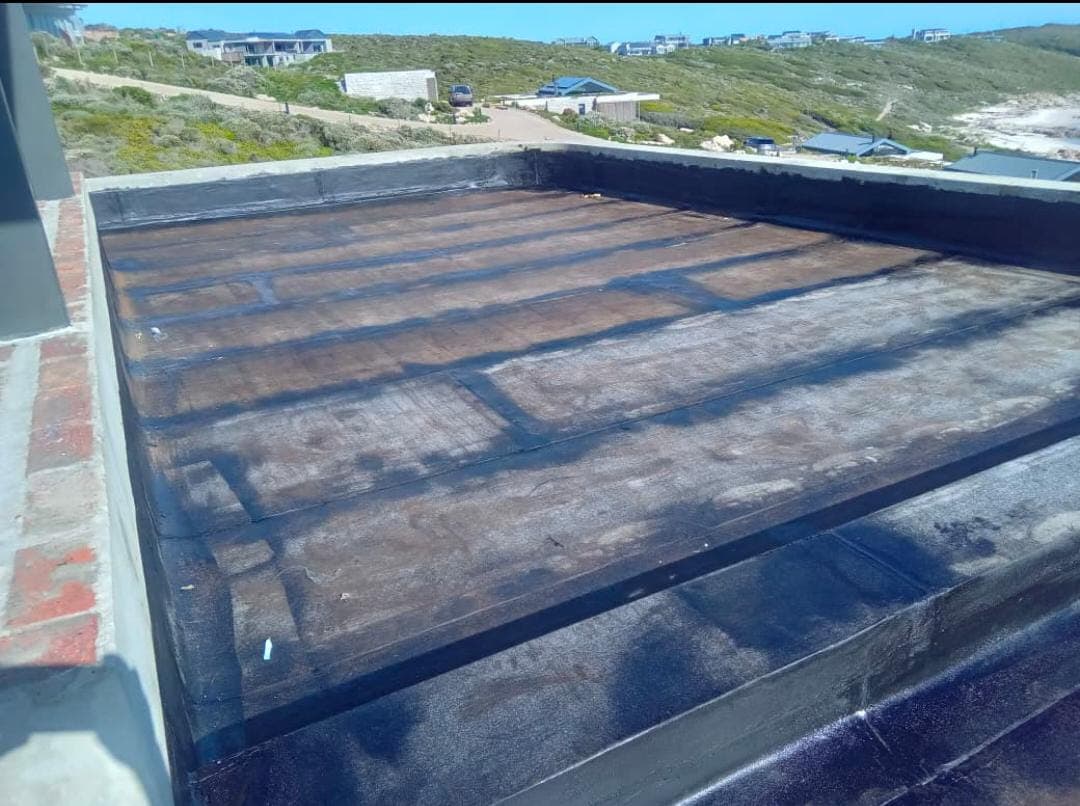
Torch-on is a thick rubberised bitumen sheet that's heat-welded with a gas torch onto a primed concrete or screed surface. It creates a near-monolithic, fully bonded layer that can handle standing water.
Use torch-on for:
- Flat concrete roof slabs (with proper falls to drainage).
- Concrete decks and balconies that are exposed to weather.
- Below-grade concrete walls in certain basement situations.
- Large flat areas where seams must be minimised.
A two-layer torch-on system ("double-touch") gives you 15–20 years of protection in the Cape climate. It can be left exposed or covered with screed/tiles afterwards.
Where it's wrong: Don't torch-on a pitched roof — it's overkill, ugly, and the heat application is dangerous near combustible timber.
When Rubberized Paint Works (and When It Doesn't)
Rubberized waterproofing paint (acrylic or polyurethane-based) is a flexible liquid coating. It's the most commonly misused product in South Africa because it's cheap and easy to apply — which tempts homeowners to use it everywhere.
It's genuinely excellent as:
- A UV-protective top coat over Uniflash or torch-on systems.
- A finish layer on pitched tile roofs that have been cleaned, primed and crack-sealed first.
- A maintenance refresh every 5–7 years on existing waterproofing.
It's genuinely not a standalone solution for:
- Parapet walls (it cracks and lifts at edges).
- Flat roofs with any standing water.
- Active leaks that haven't been properly traced and sealed.
Rubberized paint over a real waterproofing problem is a R3,000 way to ignore a R15,000 problem for one season.
The Cost of Using the Wrong System
We re-do dozens of failed waterproofing jobs each year. The pattern is consistent:
- Rubberized paint on parapets — fails within 1–2 winters as movement cracks the brittle film.
- Uniflash on a flat roof — pooling water lifts the seams within a season.
- Torch-on over old paint — won't adhere, peels off in sheets.
- One product applied over another it isn't compatible with — entire system delaminates.
The repair almost always costs 2–3× what the correct job would have. And every failed job means another winter of moisture inside the structure.
Get the Right System, the First Time
Choosing waterproofing without seeing the surface is guesswork. Our free assessments include a recommendation for the specific system your roof, walls, and exposure require — with quotes for each option.
We'll never sell you a more expensive system than you need. We'll also tell you honestly when a refresh top-coat is all that's required.
Book a free consultation and we'll match the right system to your home.